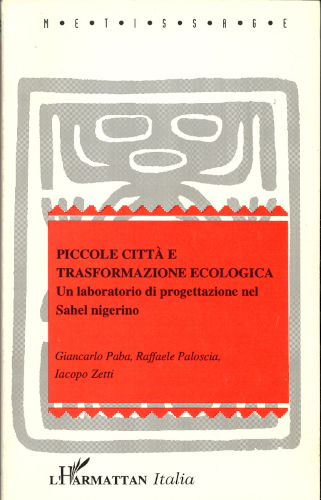
R. Paloscia; G. Paba; I. Zetti (1998). Piccole città e trasformazione ecologica. Un laboratorio di progettazione nel Sahel nigerino. Torino: L’Harmattan Italia.
Cultures based on traditional ways of life that are not purely commercial in nature, and which reflect the myriad interrelationships between local communities and the natural and built environment, now seem destined for rapid extinction. These cultures are incompatible with globalisation, an unstoppable homogenising force and one of the most pervasive myths of the end of the millennium. The Sahel is emblematic of this issue due to the variety of its cultures and the ongoing depletion of its natural and human resources.
A wide range of initiatives by grassroots groups, voluntary associations and non-governmental organisations are attempting to challenge this state of affairs and reverse the trend. These groups act as catalysts for community consensus and participation, both of which are essential for the viability of any project. The experience presented here takes place within this context, led by a university research laboratory specialising in ecological settlement design and a non-governmental organisation involved in development cooperation activities.
The project focuses on Tessaoua, a small town in southern Niger chosen as a case study due to its particularly advanced and widespread urban decay. Through continuous engagement and dialogue with the local population, we have sought to understand the town’s history, culture, and environmental knowledge, as well as the causes of its deterioration. Our goal is to define a long-term path towards sustainable development, comprising knowledge, planning, and new practices.